
Many Buffalo homeowners blame cracked driveways on bad asphalt. In reality, the problem often starts much deeper underground. Across Buffalo, Amherst, Cheektowaga, Tonawanda, Hamburg, Orchard Park, Williamsville, and surrounding Erie County communities—including ZIP codes 14216, 14221, 14224, 14225, 14226, and 14228—clay-rich soil can cause driveways to crack, sink, and fail years earlier than expected if the ground is not properly prepared before paving.
Near Delaware Park, contractors often have to deal with expansive clay driveway conditions, and near the Buffalo River, the expansive clay conditions vary significantly from season to season in the freeze-thaw cycle, particularly in the spring. In Western New York, failing to consider soil behaviour before paving can cause a newly-installed driveway to end up as a very expensive repair job in just a few years.
Erie County receives significant winter precipitation and experiences frequent freeze-thaw cycles, making proper driveway base preparation especially important for long-term pavement performance. These weather conditions place additional stress on clay-rich soils, increasing the risk of cracking, settlement, and pavement movement when proper site preparation is overlooked.
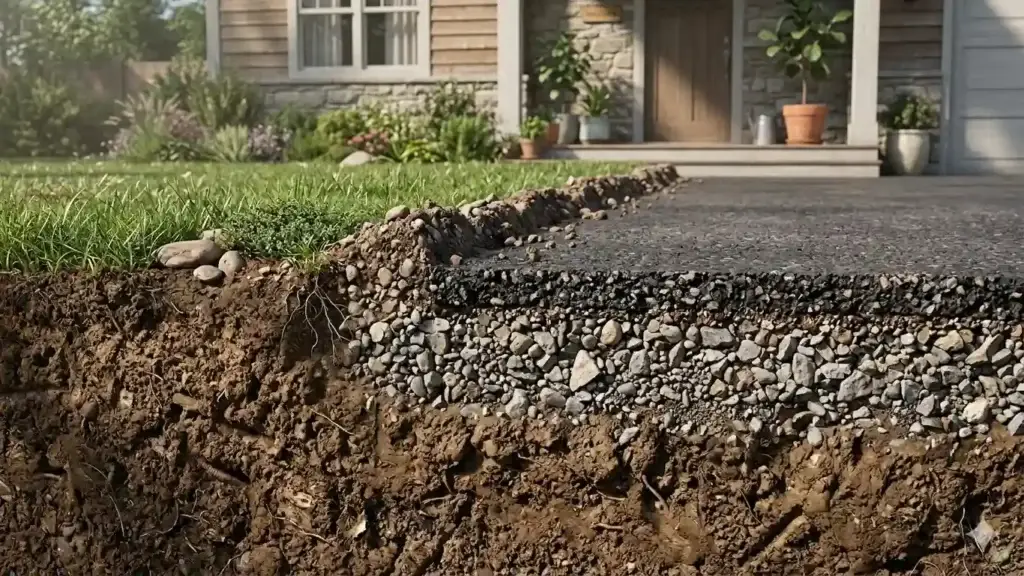
Proper compaction, drainage planning, and subgrade preparation are often the difference between a driveway that lasts five years and one that lasts twenty years for both homeowners and paving contractors. Before any Asphalt Paving in Buffalo NY project, the ground below must be correctly assessed. If not, no amount of high-quality asphalt will make up for poor soil conditions.
What Makes Buffalo Clay Soil Different?
Soils of western New York are quite different from one place to another in response to the various topography, drainage, and glacial histories. The soils around Buffalo are often very clayey and have a much greater ability to absorb and hold water compared to soils that consist of a large amount of sand or gravel. This presents long-term durability problems with asphalt.
Many experienced Buffalo paving contractors consider clay-rich soil one of the biggest hidden threats to driveway longevity because the ground can expand and contract significantly throughout the year. This constant motion puts the surface of the asphalt under pressure. The trapped moisture during the winter months in Buffalo freezes under the driveway and causes frost heave, resulting in heaving, cracking, and differential settling.
This problem is predominant in:
- Older residential neighborhoods in North Buffalo
- Suburban developments in Amherst and Williamsville
- Areas near creeks, wetlands, or low-elevation drainage zones
- Newly developed lots with disturbed soil layers
- Properties near Lake Erie where groundwater conditions fluctuate seasonally
Clay holds moisture in the soil for a long time, which affects all driveway material options including asphalt, gravel, and tar and chip, while stable granular soil does not. The soil can still be saturated even after the surface water has evaporated. This diminishes the strength of the base course and decreases the load-bearing capability needed for asphalt performance.
Many homeowners believe that a thicker asphalt surface will solve driveway problems, but grading mistakes often lead to much higher repair costs later. In reality, poor subgrade preparation is usually the primary cause of premature pavement failure.
Many homeowners believe that a thicker asphalt topcoat, the better the problem of a driveway will be resolved. But in fact, the main culprit of premature failure is usually poor subgrade preparation.
How Clay Soil Destroys Asphalt From Below
A driveway made of asphalt depends on its substructure for its strength, and early cracked driveway signs often point to deeper base issues. If the contractors do not properly stabilize the soil or do not consider drainage conditions, the pavement gradually deteriorates from below due to clay soil.
Moisture Retention Weakens the Base
Clay soils act as a continuous subsurface reservoir of water under the driveway. As time goes on, that water softens the subgrade, which means that it is less able to carry the load of vehicles. Every time the pressure of the vehicles and trucks is applied, the asphalt starts to bend too much.
This frequently causes:
- Surface cracking
- Alligator cracking patterns
- Rutting
- Edge deterioration
- Low spots that collect water
Poor drainage and clay soil exacerbate pavement stress in neighborhoods close to the Scajaquada Creek corridor or low-lying areas in Cheektowaga.
Freeze-Thaw Cycles Accelerate Damage
Expansive clay driveway systems are especially hard hit during the winter months in Buffalo! When water becomes trapped in the clay, it freezes and expands, elevating the pavement. With increasing temperatures, the soil shrinks in an unequal way.
Over time, the repeated movement will cause:
- Longitudinal cracks
- Surface separation
- Asphalt lifting
- Sunken sections
- Base instability
Some asphalt paving contractors in Buffalo, NY pay more attention to the thickness of the asphalt than to freeze-thaw soil movement under the driveway.
Poor Compaction Creates Hidden Voids
Clay soil compaction is much more difficult than compacting crushed stone or gravel. When soil is compacted while wet, it can look firm at first, but then settle unevenly.
Under Asphalt, voids may occur months after the installation. This often makes sections of the roadway near garage entrances or the driveway edges settle first due to heavy vehicle use.
Drainage Problems Multiply Soil Expansion
When the slope and drainage of the driveway aren’t planned, rainwater continues to feed into the clay underneath the driveway. Errors in grading may result in big problems in the long run.
Water near the edge of the driveway is indicative of other subgrade issues. Clogged drainage routes and aging stormwater infrastructure exacerbate the problem in many neighborhoods in western New York.
The 3 Tests Every Contractor Should Run
Installing asphalt on clay-rich soils necessitates several evaluations to see if the site needs preparation or stabilization before laying asphalt.
The savings in initial costs may be short-lived if these steps are not taken to reduce the likelihood of future repair issues.
1. Soil Moisture and Composition Testing
Testing soil before paving helps determine how much clay exists in the subgrade and how moisture-sensitive the site may become.
Professional contractors can use:
- Soil probes
- Moisture meters
- Compaction testing equipment
- Soil classification analysis
- Load-bearing evaluations
These tests are used to determine if the driveway needs excavation, stabilization fabric or extra depth of aggregate.
Testing is even more critical near Ellicott Creek, Tonawanda Creek, or older Buffalo residential areas where drainage histories are poor.
2. Compaction Density Testing
The compaction of clay soil should be adequate and at least at the required densities before the laying of the asphalt. The asphalt surface will fail over time if the subgrade is soft, unstable, or uneven.
Contractors typically evaluate:
- Moisture content during compaction
- Density percentages
- Subgrade firmness
- Rut resistance
- Surface stability
Compaction may be repeated several times with the use of special equipment and moisture content control.
3. Drainage and Grading Evaluation
In Western New York, virtually every aspect of the life of a driveway is impacted by drainage. Before paving begins, contractors should review the site to determine the flow of water throughout the area.
Important factors include:
- Slope direction
- Downspout discharge locations
- Low elevation zones
- Surface runoff patterns
- Existing drainage infrastructure
Clay soil drainage solutions may involve regrading, installing drainage channels, adding stone layers, or redirecting runoff away from the driveway base.
Without these corrections, water infiltration continues weakening the soil year after year.
How to Fix Clay Soil Before Paving
Fortunately, the problems with clay soil can often be controlled successfully by proper preparation techniques. Stabilizing the subgrade before the start of the asphalt placement process is critical to long-lasting asphalt solutions.
Excavating weak soil layers
In the most extreme cases, the unstable parts of the clay walls are cut out and replaced with compacted granular material. This provides a more solid base, which is not subject to movement and will not retain water.
While working out the initial costs of excavation might be higher, it can save much more later when repairs may become costly.
Installing a Strong Aggregate Base
When paving over clay soil, the base course thickness must be correct. A lot of contractors use multiple layers of crushed stone bases to disperse the weight of vehicles.
The following are factors that can benefit when using thicker aggregate bases:
- Improve drainage
- Reduce soil movement
- Increase load stability
- Minimize frost heaving
- Extend asphalt lifespan
In Buffalo-area climates, thin bases frequently fail within only a few winters.
Using Geotextile Stabilization Fabric
Clay soil is separated from a stone base above by using geotextile fabrics. This will help prevent settling of the aggregate over time into soft subgrade material.
Benefits include:
- Improved structural stability
- Better drainage performance
- Reduced soil migration
- Longer pavement life
- Stronger compaction results
This method is increasingly common in newer asphalt paving Buffalo NY projects involving poor soil conditions.
Correcting Drainage Problems
Effective clay soil drainage solutions are essential for preventing water accumulation beneath asphalt.
Typical drainage modifications are:
- Regrading slopes
- Extending downspouts
- Installing French drains
- Adding swales
- Improving runoff channels
Before paving, consider upgrading the drainage system around homes near the lower elevations in South Buffalo, West Seneca, and Lackawanna, as it can make a huge difference.
Allowing Proper Soil Drying Time
A common mistake is paving over saturated clay soil before moisture levels have stabilized. Wet clay is difficult to compact properly and can lead to future settling, cracking, and pavement failure.
For experienced paving crews, it may be possible to wait until soil moisture conditions are stable before installation. This will slightly lengthen the project, but it will have a much better long-term durability effect.
Quick Tip: Ask These Questions Before Hiring
Not all contractors are equipped to deal with clay soil. Homeowners should ask a paving company a few questions before committing to a paving job, regarding soil evaluation and preparation.
Here are some questions to consider:
Do You Test Soil Before Paving?
Testing soil before paving helps identify hidden issues that may affect the driveway’s lifespan. Contractors who skip this step may rely only on visual inspection.
How Thick Will the Base Course Be?
The thickness of the base course has a direct impact on the durability on clay heavy properties. Thin bases tend to fail early in Buffalo’s freeze-thaw weather.
What Drainage Improvements Are Included?
The installation of proper drainage is just as important as the installation of the asphalt itself. Discuss what will be done with runoff and groundwater around the driveway.
Will You Use Soil Stabilization Methods?
Depending on the property, contractors may advise the use of geotextile fabric, extra stone, or soil replacement to enhance stability.
Have You Worked With Western New York Soil Types Before?
Local experience matters. Contractors know the conditions in Erie County soil and know how weather conditions over the years affect asphalt.
Why Local Experience Matters in Buffalo
The unique climate, soil characteristics, and winter weather of Buffalo pose challenges to paving contractors outside of the area. Local knowledge gives the paving crews a heads-up on potential trouble spots before problems become too severe.
With years of experience performing Asphalt Paving, Driveway Paving, and Asphalt Repair throughout Erie County, experienced local contractors understand how Buffalo’s clay-rich soils, lake-effect precipitation, and freeze-thaw cycles affect pavement performance. This knowledge helps identify potential subgrade and drainage issues before they become costly repairs.
Contractors with experience know how:
- Lake-effect precipitation affects drainage
- Freeze-thaw cycles stress asphalt foundations
- Clay-rich soil behaves seasonally
- Older neighborhoods may contain unstable fill material
- Snowmelt impacts driveway edges and low areas
Regardless of the location of the property, whether Elmwood Village, Kenmore, Lancaster, or Orchard Park, subgrade preparation is one of the biggest factors in pavement performance.
Final Thoughts
A smooth asphalt driveway may appear strong on the surface, but it is the underlying soil and base that truly provide strength. Many driveways experience cracking, settlement, and surface deterioration because of unstable clay soil conditions across Buffalo and Western New York, and many projects are failing to do the necessary evaluation and stabilization.
The optimal asphalt solutions start well before the asphalt truck arrives. Proper preparation can help prevent cracking, sinking, and premature pavement failure by proper compaction, drainage corrections, testing, and subgrade preparations of clay soils.
For homeowners considering a new driveway or replacement project, asking the right questions now can prevent thousands of dollars in repairs later. In Buffalo’s demanding climate, investing in proper preparation is often the difference between a driveway that lasts five years and one that lasts twenty.
Frequently Asked Questions
Is clay soil bad for driveways?
Yes, clay soil can be very problematic for driveways, especially in Western New York. Clay has the property of expanding upon absorbing water and contracting when dry. This continuous motion produces pressure under the pavement, resulting in cracking, uneven surfaces, and settling. Many paving contractors in Buffalo NY, homeowners hire would recommend that a soil test be sent before the installation, because this will help to ensure that the long-term effects will not be harmful.
How to prepare clay soil for asphalt?
There are several crucial steps in preparing a clay soil. Before paving, contractors typically will conduct soil testing to get an indicator of moisture and soil stability. The area may then need to be excavated, soil stabilized, geotextile fabric installed, and a thicker crushed stone base installed. Good compaction and correction of drainage are also important prior to asphalt paving Buffalo NY projects.
Why does clay soil cause cracking?
Roughly speaking, the reason for cracking in clay soils is that they can expand and contract with moisture fluctuations. In wet weather, the ground expands, forcing the asphalt up. When it is dry or in the winter months, the soil shrinks or moves irregularly. This action causes surface cracking, stress fractures, and ultimately large pavement failures.
What is the recommended base course thickness for clay soil?
The thickness of the base course will vary depending on the soil type, traffic loading, and drainage, but clay soils may need a thicker aggregate base than other soils. Many asphalt paving Buffalo NY companies recommend adding more crushed stone layers to increase stability, decrease the amount of moisture, and enhance the longevity of the driveway.
What are the best clay soil drainage solutions for driveways?
Some of the best solutions for clay soil drainage include French drains, proper grading, swales, extended downspouts, and permeable stone layers under the driveway. These systems aid in the drainage of water from the subgrade and minimize soil expansion. One of the most significant factors that can cause asphalt cracking and early failure of your driveway is inadequate drainage.