
Driveways across Buffalo are failing faster than many property owners expect. One of the biggest reasons is hidden below the surface: poor site preparation combined with Buffalo’s heavy clay soil conditions. From homes in Amherst and Cheektowaga to properties near Elmwood Village, North Buffalo, and the 14221 and 14216 zip code areas, improperly prepared land leads to cracked asphalt, sinking pavement, drainage problems, and expensive repairs.
Many homeowners believe that if they’re getting fresh asphalt, they’re getting quality work. But this is not always the case. A flat driveway can begin to fail in a year if it was excavated too quickly or if the preparation of the base is incorrect.
When Buffalo homeowners call for asphalt repair services, experienced paving professionals often inspect the foundation first because most pavement failures begin below the surface. In Western New York, the soil, which expands when wet and shrinks when dry, is very important as excavation depth requirements, base thickness, moisture control, and full compaction are all important.
When you install new asphalt paving Buffalo, NY homeowners require, and also when you need to replace an older driveway, it’s important to know the warning signs of poor excavation to prevent you from having to pay big repair charges later.
Water expands by approximately 9% when it freezes, which is one reason freeze-thaw cycles can create significant pressure beneath asphalt pavement. Repeated freeze-thaw cycles create significant pressure beneath asphalt surfaces, making proper base preparation and drainage essential for long-term pavement performance in Western New York.
Even small amounts of trapped moisture can gradually weaken the aggregate base and reduce the pavement’s load-bearing capacity over time.
Why Buffalo Clay Soil Creates Serious Paving Problems
Clay-heavy soil is found throughout Western New York, particularly in the suburbs of Clarence, West Seneca, Lancaster, Orchard Park, and Tonawanda. Clay will hold water in the soil for a longer time compared to sandy soil, which drains naturally.
Our team has repaired and replaced driveways throughout Buffalo, Amherst, Clarence, Cheektowaga, Lancaster, and West Seneca for years. One pattern appears repeatedly when we investigate failing pavement: the problem often starts below the surface. Many driveways that crack, sink, or develop drainage issues within just a few years suffer from inadequate excavation depth, poor soil compaction, improper aggregate base installation, or insufficient drainage planning. These site preparation mistakes are especially costly in Western New York, where clay-heavy soils and harsh freeze-thaw cycles place additional stress on pavement foundations.
When the weather turns cold in Buffalo, the ice and snow melt and leave trapped water underneath the asphalt, which expands. During spring and summer, the same soil shrinks as it dries out. This repetitive action causes damage to pavement foundations and ultimately damages the pavement surface.
Professional paving contractors in Buffalo, NY know that successful pavement installation begins long before the asphalt is placed. A skilled contractor should remove unstable soil, perform proper subgrade stabilization, install a well-compacted aggregate base course using materials such as crushed limestone, and ensure adequate drainage before asphalt installation begins. Depending on site conditions, geotextile fabric may also be used to improve separation between soil layers and increase long-term load-bearing capacity.
All Pro Paving Service, 105 Delta Rd, Buffalo, NY 14226, (716) 666-4241 has experience handling these types of site conditions across Buffalo and surrounding Western New York neighborhoods.
When these steps are skipped or rushed, warning signs often begin appearing within the first few seasons after installation.
Sign #1: Asphalt Is Thinner Than It Should Be
Probably one of the most frequent excavation errors is using the wrong thickness of asphalt standards. Some contractors skimp on the thickness of asphalt layers, which is not suitable for Buffalo’s climate and soil.
Professional paving crews often perform soil compaction testing and use equipment such as vibratory rollers and plate compactors to ensure the subgrade and aggregate base achieve the density required to support vehicle traffic throughout Buffalo’s changing seasons.
Most Buffalo residential driveways will need:
- A properly compacted stone base
- Proper excavation depth
- Multiple asphalt layers
- Thickness suited for vehicle traffic and soil conditions
When the asphalt is too thin, the surface starts to flex when loaded. This causes cracks, edges that drop, and also early wear and tear with time.
Warning Signs of Thin Asphalt
You may notice:
- Tire impressions during hot weather
- Cracking shortly after installation
- Edges crumbling apart
- Surface movement when vehicles pass
- Soft or flexible pavement sections
Adding to the danger of thin asphalt is a wet, damp clay soil below. The pavement becomes structurally unsound and starts to crack and crumble.
Many asphalt repair professionals find that failing driveways were originally installed over shallow excavations or poorly prepared base layers.
Why is the depth of excavation important?
Appropriate excavation depths are determined by:
- Soil type
- Water retention levels
- Drainage slope
- Vehicle weight
- Existing subgrade conditions
High moisture levels in Buffalo area neighborhoods near Delaware Park and properties close to the Buffalo River corridor typically require deeper excavation and stronger bases of aggregate.
If the driveway is not deep enough, it doesn’t rest upon stable ground.
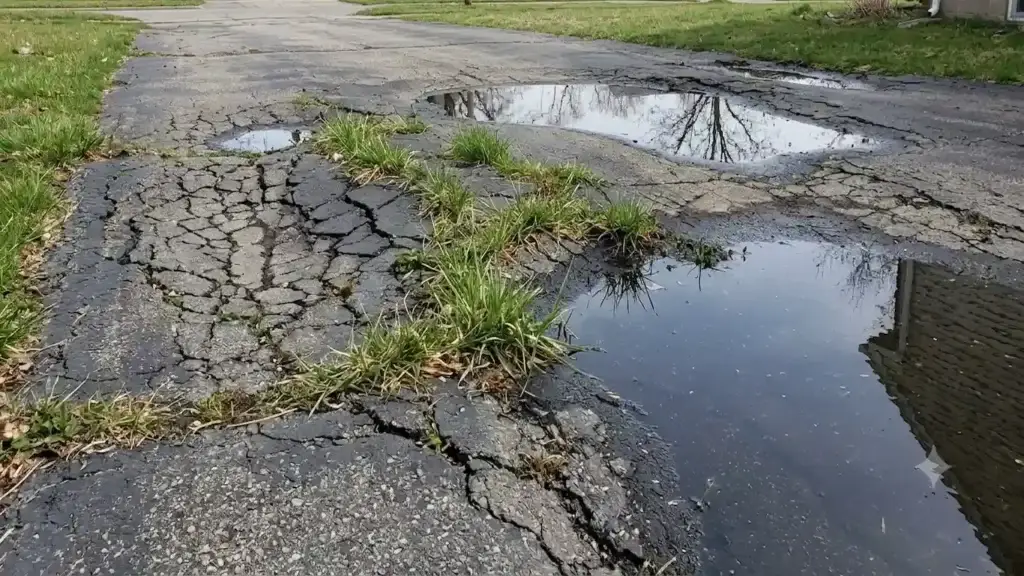
Sign #2: Vegetation Growing Through Cracks
If the grass, weeds, or moss are growing through cracks in the asphalt surface, it is a sign that the site below the pavement is not being well prepared.
This typically involves a situation in which contractors did not:
- Remove organic material left under asphalt
- Eliminate roots and vegetation completely
- Install sufficient base material
- Compact the subgrade properly
Organic materials are slowly breaking down under the asphalt over time. They decay, and voids develop under the surface of the pavement, which degrades the pavement.
Why Organic Material Causes Failure
Moisture and unstable organic matter are found in the tree roots, grass layers, mulch, and topsoil. These materials should not be left under paving.
Unfortunately, excavation crews are often too rushed to pave right over:
- Old grass
- Loose soil
- Roots
- Decaying vegetation
- Wet topsoil
This will lead to issues of settlement in the future.
Drainage issues may cause soil movement in many homes in South Buffalo and the vicinity of Cazenovia Creek, especially when the organic material has not been removed properly.
As vegetation grows through cracks, water penetrates even more quickly. The freezing-thawing process speeds up, and the damage spreads rapidly throughout the driveway.
What Professional Contractors Should Do
Reliable asphalt paving Buffalo, NY professionals should:
- Remove all topsoil completely
- Excavate to stable subsoil
- Install compacted aggregate layers
- Check moisture levels carefully
- Ensure no organic debris remains
These steps will help to provide a pavement foundation that will last through the years and hold up against Buffalo weather.
Sign #3: Low Spots Where Water Pools
Pooling water is one of the clearest site prep red flags property owners can spot immediately after paving.
Rainwater that sits on the driveway for more than 24 hours will likely have issues below the surface.
Proper grading helps direct surface runoff away from the pavement structure, reducing water infiltration and minimizing the risk of frost heave during winter months.
Why Poor Drainage Destroys Asphalt
The most significant adversary to asphalt pavement is water.
When water enters weak areas, it:
- Softens the base layer
- Weakens soil stability
- Causes compaction failure
- Accelerates cracking
- Expands during freezing temperatures
The clay soils of Buffalo make drainage even more critical due to the inability of water to flow easily through the dense clay layers.
Standing water issues are common in areas that are close to Lake Erie and in low-lying areas of Cheektowaga when the grading is not done properly before paving.
Common Drainage Mistakes
Poor contractors may:
- Ignore slope calculations
- Use uneven grading
- Install an improper base thickness
- Leave low excavation points
- Skip proper compaction
The cost of even the smallest of drainage mistakes adds up!
Signs of Poor Drainage
Watch for:
- Puddles after rainstorms
- Water is flowing toward the garages
- Dark moisture spots
- Moss growth
- Sinking pavement areas
- Erosion along driveway edges
Many of these issues may be signs of hidden problems below the surface of the asphalt pavement.
Often, asphalt repair services will be called upon to address damage that occurred during initial construction due to improper water management.
Sign #4: Cracks Follow a Pattern of Weak Spots
Cracking patterns are rarely random.
Cracks in many Buffalo driveways can show when there is a flaw in the pavement below, whether it is due to cracking or compaction.
How Compaction Failure Happens
Compaction failure is when contractors fail to properly compact the soil and aggregate base before paving.
Without sufficient compaction:
- Soil shifts under weight
- Voids form beneath asphalt
- Moisture settles unevenly
- Weak spots develop
As time passes, it is these unstable areas that start to crack and form cracks directly over the unstable areas.
Common Crack Patterns
Inadequate site preparation can lead to:
- Long parallel cracks
- Spiderweb cracking
- Repeating rectangular patterns
- Cracks near edges
- Depressions around tire paths.
These problems are commonly seen on older Buffalo homes within the historic districts, as older subgrades often already contain unstable fill.
Why Buffalo Freeze-Thaw Cycles Make It Worse
Asphalt surfaces are subjected to a lot of stress during Buffalo winters.
All during the winter, water seeps into the small cracks, freezes, expands, and pushes the pavement apart over and over. The areas where the soil is not compacted properly deteriorate first as they absorb more moisture.
That’s why it’s important for the experienced paving contractors Buffalo NY trusts to spend a considerable amount of time preparing and compacting the base before the installation of the asphalt begins.
Quick Tip: How to Inspect Before You Pay the Final Invoice
If the excavation work is done by a contractor, property owners should always have it checked before paying.
However, as a non-expert paving professional, you can still spot key red flags.
How to Inspect Excavation Work
Before installing asphalt, tests are performed for all of the following:
- Proper excavation depth
- Clean removal of vegetation
- Uniform stone base thickness
- Smooth grading slopes
- Compacted aggregate layers
- No standing water
- Stable driveway edges
While paving, monitor for consistent use of compaction equipment.
Questions to Ask Your Contractor
Ask:
- What excavation depth requirements are being followed?
- How thick is the aggregate base?
- Was all organic material removed?
- How is drainage being handled?
- What asphalt thickness standards are being used?
- How many compaction passes were completed?
When responding to the question, professional contractors should be confident in their answer and clearly explain the process.
Why Proper Site Preparation Saves Money
Without knowledge of the quality of excavation, many homeowners opt for the cheapest quote provided for paving.
When paving work is cheap, critical preparation activities are sometimes not performed, as it cuts down on the labour and material costs.
Unfortunately, those shortcuts often result in:
- Early cracking
- Water damage
- Sinking pavement
- Repeated patching
- Costly reconstruction
By investing in proper site preparation and professional asphalt repair services, you ensure that your driveway lasts for years to come.
The foundation in Buffalo’s cold weather environment is just as important as the asphalt.
Choosing the Right Paving Contractors in Buffalo, NY
Property owners should check before hiring a contractor:
- Local experience with Buffalo clay soil
- Knowledge of freeze-thaw conditions
- Proper excavation equipment
- Drainage planning expertise
- Compaction procedures
- Base installation standards
Asphalt paving Buffalo, NY professionals understand the importance of weather and soil conditions on the long-term performance of asphalt.
They also know that each Property presents unique challenges regarding grading, moisture, and soil stability.
Conclusion
The clay in Buffalo soil can cause asphalt driveways to have certain problems, particularly if the excavation was conducted too quickly or the standard of preparation was not met.
Some of these issues that should be addressed include warning signs of the site being improperly prepared before paving, such as thin asphalt, weed growth, pooling water, and patterned cracking.
Whether you are installing a new driveway or scheduling asphalt repair services, understanding these site prep red flags can help you avoid major structural failures and expensive future repairs.
In the West, proper excavation depth requirements, planning for drainage, compaction requirements, and removing organic material are key to long-lasting pavements.
The best way for Buffalo homeowners to ensure their driveway will withstand the rigors of Buffalo weather for years is to work with the experienced paving contractors Buffalo.
Buffalo’s climate creates unique challenges for asphalt surfaces. Heavy snowfall, spring runoff, lake-effect weather, and frequent freeze-thaw cycles place significant stress on pavement foundations. Without proper excavation, subgrade stabilization, compaction, and drainage control, even newly installed asphalt can begin showing signs of distress much sooner than expected. Investing in proper site preparation helps extend pavement life, reduces maintenance costs, and protects the overall structural integrity of the driveway.
FAQs
How to tell if site prep was done wrong?
Uneven surfaces, pooling water, early cracking, vegetation growth, and sinking pavement often indicate poor excavation and improper driveway preparation.
What are the signs of poor excavation?
Common signs include soft pavement, water puddles, weak edges, repeated cracking patterns, and uneven asphalt settlement after installation.
Can I check the excavation quality?
Yes. Check excavation depth, drainage slope, compacted stone layers, and whether vegetation or organic material was completely removed.
Why does Buffalo clay soil damage asphalt?
Clay soil retains water, expands during freezing weather, and shifts over time, causing asphalt cracking and foundation instability.
What causes compaction failure in driveways?
Compaction failure happens when contractors do not properly compress the soil and stone base before asphalt installation begins.
How thick should residential asphalt be?
Proper asphalt thickness depends on soil conditions, drainage, and vehicle traffic, but Buffalo driveways typically require multiple durable layers.
Why is drainage important for asphalt paving?
Poor drainage allows water to weaken the base layer, causing cracks, sinking, and pavement deterioration during freeze-thaw cycles.
Can weeds growing through asphalt indicate a problem?
Yes. Vegetation growth usually means organic material was left under asphalt or cracks are allowing moisture penetration.
How long should a properly installed driveway last?
A well-prepared asphalt driveway in Buffalo can last 15 to 25 years with proper maintenance and drainage control.
Should I repair or replace cracked asphalt?
Minor cracks may need repairs, but widespread cracking and sinking usually indicate deeper base problems requiring replacement.