
Most driveway failures in Buffalo do not begin on the surface. They begin underneath the asphalt, where the soil, base, grading, drainage, and compaction decide how long the driveway will actually last.
A homeowner usually notices the problem only after the surface starts showing cracks, potholes, sunken areas, loose edges, or standing water. But by that point, the real issue may already be deeper than the asphalt layer. This is why asphalt repair services should not begin with only one question: “Can this be patched?” The better question is: “Why did the driveway fail so fast?”
Buffalo driveways face a difficult combination of clay-heavy soil, snow, salt, spring thaw, heavy summer rain, and repeated freeze thaw damage. When the base is prepared correctly, asphalt can handle normal seasonal stress much better. But when poor base preparation, weak subgrade compaction, drainage failure, or grading mistakes are ignored, the driveway starts moving from below.
That movement is what causes early cracking.
This is also why two driveways in the same Buffalo neighborhood can age very differently. One may stay stable for years, while another may start cracking after the first winter or settling after a few heavy summer rainstorms. The difference is usually not only asphalt thickness. It is the quality of proper site preparation.
Buffalo driveway problems often show up across older residential areas and surrounding suburbs, including 14226, 14216, 14214, 14221, 14223, 14225, 14207, and 14220. Homes near Amherst, Snyder, Kenmore, Tonawanda, Cheektowaga, Williamsville, North Buffalo, and South Buffalo can all face the same basic issue: the asphalt surface is only as strong as the soil, base, grading, and drainage underneath it.
If you are planning asphalt paving, driveway repair, resurfacing, or full-depth asphalt repair, start by understanding the foundation. You can also review our guide on proper site preparation and our full asphalt services before making a decision.
For homeowners searching for asphalt repair services, driveway repair, or paving contractors Buffalo NY, this page explains why many driveways fail before their expected lifespan. All Pro Paving Service serves Buffalo, Amherst, Cheektowaga, Tonawanda, and all of Erie County. For inspection and repair guidance, call 1 716 666 4241.
The #1 Cause: Buffalo’s Clay Soil
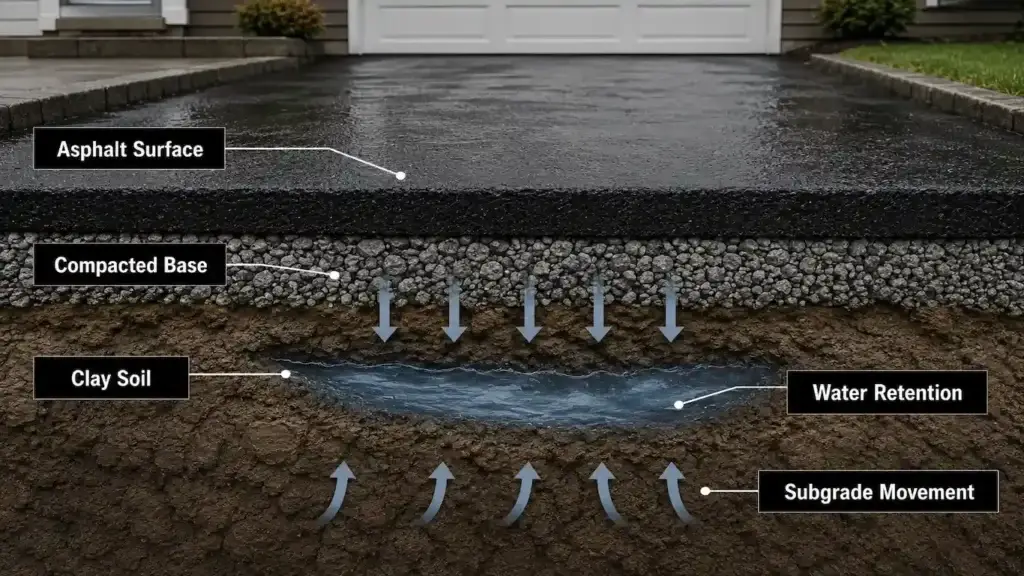
Buffalo clay soil problems are one of the biggest reasons driveways fail earlier than expected. Clay soil behaves very differently from clean, well-draining granular material. It holds moisture, becomes soft when wet, can shrink when dry, and can move during seasonal temperature changes.
That movement matters because asphalt is flexible, but it still needs a stable foundation.
A driveway is not just asphalt. A proper driveway system includes the prepared subgrade, compacted aggregate base, and asphalt surface. If the soil underneath the base is weak, wet, organic, loose, or poorly compacted, the asphalt above it will eventually reflect that weakness.
This is one of the most common driveway failure causes in Buffalo neighborhoods, especially in residential areas where older driveways may have been built over shallow base material, poor fill, tree roots, soft soil, or ground that was never properly corrected before paving.
For local soil context, homeowners can check the USDA NRCS Web Soil Survey, which provides soil data and information produced by the National Cooperative Soil Survey. The NRCS states that Web Soil Survey gives online access to soil and related information used for land-use and management decisions.
Clay does not drain like sandy or stone-based material. When water enters the pavement system, clay can hold that moisture. During colder months, that moisture can freeze and expand. During warmer months, especially summer, homeowners may finally see the result: cracks that opened during winter, low spots from base movement, edge breaks, and potholes where the surface lost support.
This is why summer is a practical time to inspect Buffalo driveways. Once the snow is gone and the surface is dry, the real condition becomes easier to see. Cracks, edge breaks, sinking sections, and drainage patterns are more visible. After a summer rain, you can also see where water collects, where it runs backward, and where the driveway is not shedding water properly.
Proper site preparation should have started with soil evaluation. If the existing soil was soft, loose, organic, saturated, or unstable, it should not have been treated as a structural foundation. Weak material should be removed or corrected before the aggregate base is installed.
The next step should have been subgrade compaction. Subgrade compaction means preparing the soil layer so it can support the driveway evenly. If this step is skipped or done lightly, the driveway may continue settling after asphalt is placed.
That is when homeowners start seeing cracks that are not random. They follow weak spots. They appear in wheel paths. They form around low areas. They return after patching because the original support problem is still there.
Poor base preparation over clay soil is especially risky because the base can become contaminated. If stone is placed over soft clay without proper preparation, the stone can press into the clay. Over time, the base loses its clean structure. Instead of locking together and distributing load, it starts mixing with wet soil.
That is when residential asphalt repair Buffalo homeowners need may go deeper than the surface. A simple patch may cover the failed area for a short time, but if the base is moving, the patch will move too.
A proper inspection should check whether the driveway has surface wear or structural failure. Surface wear may include light cracks, oxidation, or minor raveling. Structural failure may include alligator cracking, sinking, soft spots, repeated potholes, or water collecting in the same place again and again.
If the problem is structural, proper asphalt repair services may require cutting out the failed area, removing weak base material, correcting the subgrade, compacting new aggregate, and then placing new asphalt.
That is the difference between covering failure and fixing failure.
What Happens When Grading Is Done Wrong
Grading controls where water goes. In Buffalo, that is not a small detail. It is one of the biggest differences between a driveway that lasts and a driveway that fails early.
A driveway should move water away from the garage, foundation, sidewalk, and asphalt surface. If the slope is wrong, water sits on the driveway or runs into areas where it should not go.
Common grading mistakes Buffalo homeowners see include low spots, reverse slope toward the garage, flat driveway sections, weak edges, water flowing toward the house, and poor transition where the driveway meets the street or sidewalk.
At first, these mistakes may look minor. A small puddle may not seem serious. A flat section may not look like a construction problem. But water is one of the most damaging forces in asphalt pavement.
When water sits on the surface, it slowly enters small cracks and open edges. When it reaches the base, it weakens the support system. When the temperature drops, that trapped water can freeze and expand. When it thaws, it leaves space for more water to enter.
This freeze thaw damage cycle can widen cracks, loosen asphalt, soften the base, and create potholes.
In summer, grading problems become easier to diagnose because rainwater shows the real drainage path. After a heavy rain, a properly graded driveway should drain instead of holding water. If puddles remain for hours, especially near the garage, edges, or low center areas, that is a warning sign.
Grading should have been planned before paving started. The contractor should have looked at the driveway’s existing slope, garage elevation, yard elevation, street connection, sidewalk transition, and nearby drainage paths.
A narrow Buffalo city lot may need a different grading plan than a wider property in Amherst or Cheektowaga. A driveway near Delaware Park, Snyder, Kenmore, or Williamsville may have different site conditions than a driveway closer to South Buffalo or Tonawanda. The principle is the same, but the grading solution must match the property.
Good grading does not mean water is simply pushed somewhere else. It means water is directed safely and consistently without damaging the driveway, garage, lawn, sidewalk, or nearby structures.
When grading is done wrong, the asphalt is forced to sit in wet conditions. That can lead to cracking, surface raveling, potholes, and base failure. If a repair is done without correcting the grade, the same section often fails again.
This is why asphalt repair services in Buffalo should include a drainage and slope check. If the driveway has failed in the same low area twice, the issue is probably not only the patch material. The water path may be wrong.
Proper site preparation should have looked like this: establish the correct grade, prepare the subgrade to match that grade, install and compact the base evenly, then place asphalt at the proper slope so water can move away.
A smooth driveway is not enough. A driveway must drain correctly.
Suggested grading diagram placement: Add a visual directly under this section showing correct slope away from the garage, incorrect reverse slope toward the garage, water flow arrows, and a side-by-side “correct grade” versus “wrong grade” comparison.
The Hidden Cost of Skipping Base Compaction
Base compaction is one of the least visible parts of driveway construction, but it has one of the biggest effects on long-term performance.
When a contractor skips proper compaction, the driveway may look fine at first. The asphalt surface can appear smooth, black, and finished. But underneath, the base may still be loose, uneven, or unstable.
That is when the driveway starts compacting under real traffic instead of during construction.
Cars, delivery vans, garbage trucks, trailers, and snow removal equipment all place weight on the driveway. If the base was not compacted properly before paving, these loads can push the base down unevenly. The result is rutting, dips, edge failure, cracks, and low spots.
Subgrade compaction and aggregate base compaction are not the same thing, but both matter.
Subgrade compaction prepares the soil layer. Aggregate compaction prepares the stone base. If either one is weak, the driveway loses uniform support.
One major mistake is placing too much stone at once and compacting only the top. Compaction should happen in controlled layers. If a thick layer of aggregate is dumped and rolled only at the surface, the lower material may remain loose. Over time, it can shift, settle, and create movement under the asphalt.
Another mistake is not extending and compacting the base properly near the edges. Driveway edges are vulnerable because they often sit next to lawn, soil, or landscaping. If the edge does not have support, it can crack or crumble when tires get too close.
This is especially common where driveways are widened without proper base extension. The widened section may look good at first, but if the new edge was not excavated, based, and compacted correctly, it may fail faster than the original driveway.
Poor base preparation is also a cost issue. A cheaper paving quote may leave out excavation depth, proper aggregate thickness, soft soil correction, drainage adjustment, or compaction requirements. The driveway may cost less on installation day, but it can cost more later through repairs, patching, resurfacing, or full replacement.
This is where homeowners should ask direct questions before work begins.
- How deep will the area be excavated?
- Will soft soil be removed?
- What type of stone base will be used?
- How thick will the compacted base be?
- Will the base be installed in lifts?
- How will the subgrade be compacted?
- How will the edges be supported?
- How will drainage be handled?
These questions are not technical overkill. They are basic asphalt failure prevention.
For homeowners comparing asphalt repair services or driveway paving contractors in Buffalo NY, this matters because not all repairs are the same. If a driveway already has alligator cracking, sinking areas, repeated potholes, or water pooling in the same location, a surface repair may not be enough.
Full-depth asphalt repair services may be needed. That means the failed asphalt and weak base are removed, the foundation is corrected, and the repair is rebuilt from the bottom up.
A surface patch is useful only when the underlying structure is still sound. If the base failed, the patch becomes temporary.
The hidden cost of skipping compaction is that the driveway does not fail evenly. It fails in sections. One side sinks. One wheel path cracks. One corner breaks. One low spot keeps holding water. These uneven failures make the driveway look older than it is and create recurring repair problems.
Proper compaction is not cosmetic. It is structural.
Quick Driveway Failure Diagnosis Table
| Problem | Likely Cause | Repair Type |
| Alligator cracking | Base failure | Full-depth repair |
| Standing water | Grading issue | Drainage correction |
| Edge cracking | Weak support | Edge rebuild |
| Early cracks | Poor compaction | Structural repair |
| Repeated potholes | Weak or wet base | Full-depth patching |
| Sunken wheel paths | Base settlement | Base correction + resurfacing |
| Cracks near garage | Reverse slope or trapped water | Grading correction |
| Loose asphalt edges | No edge support | Edge rebuild + compaction |
Drainage: The Silent Driveway Killer
Drainage failure driveway problems often start quietly. A small puddle forms after rain. A crack appears near the low spot. The edge stays damp. The surface begins to loosen. Then the same area becomes a pothole.
By the time the damage is obvious, water may have already weakened the base.
Buffalo driveways deal with water in several forms: rain, snowmelt, roof runoff, garage runoff, yard drainage, and moisture trapped in clay soil. If the driveway is not graded correctly or the base does not drain well, water stays inside the pavement system longer than it should.
Water weakens asphalt in two ways.
First, it damages the surface. Water enters small cracks, carries debris into openings, and helps break down weak areas. In winter, that water freezes and expands, making cracks wider.
Second, it damages the base. A wet base cannot support load as well as a dry, compacted base. If the subgrade softens, the asphalt flexes. When asphalt flexes repeatedly, it cracks.
That is why drainage should be planned before paving, not after.
A proper drainage review should check downspouts, garage apron slope, yard elevation, sidewalk transition, street connection, driveway edges, and existing low spots. If roof water is being dumped directly onto or beside the driveway, that should be corrected. If the lawn slopes toward the driveway, the edge may stay wet. If the garage apron slopes backward, water may sit near the structure.
In summer, this becomes easier to see. After a heavy Buffalo rain, look at the driveway before it fully dries. The wet areas tell the truth. If the same section stays wet longer than the rest, that area may have poor slope, weak drainage, or base saturation.
This summer inspection can help decide whether the driveway needs basic maintenance, targeted repair, drainage correction, or full reconstruction.
Not every crack means the driveway is failing structurally. Some cracks are normal aging. But cracks combined with ponding water, sinking, soft edges, or repeated potholes usually point to a deeper issue.
Experienced paving contractors in Buffalo NY should not recommend the same repair for every driveway. A driveway with minor surface cracking may need crack filling and maintenance. A driveway with poor drainage may need grading correction. A driveway with failed base material may need full-depth repair.
The repair should match the cause.
That is the main difference between temporary asphalt repair and proper asphalt failure prevention. Temporary repair focuses on what is visible today. Proper repair asks what caused the damage and what will stop it from returning.
- If water caused the failure, water must be redirected.
- If clay soil movement caused the failure, the subgrade and base must be corrected.
- If poor base preparation caused the failure, the weak section must be rebuilt.
- If grading mistakes caused the failure, slope must be fixed before new asphalt is placed.
A driveway is only as strong as the system underneath it.
Quick Tip: 3 Things to Check Before Any Paving Starts
Before starting asphalt paving, driveway paving, or residential asphalt repair services in Buffalo,NY, check three things: soil, slope, and base.
First, check the soil. If the existing ground is soft, wet, full of roots, organic material, old fill, or clay that holds water, it should not be ignored. The soil must be prepared before the base is installed. Paving over weak soil only hides the problem for a short time.
Second, check the slope. Water should move away from the driveway, garage, foundation, and walking areas. If water has no clear path, it will eventually find a weak point in the asphalt system. Summer is a good time to check this because rain patterns are easier to observe without snow covering the surface.
Third, check the base. The aggregate base should be thick enough, clean enough, and compacted enough to support the driveway. It should not be loose, contaminated with soil, or thin near the edges.
A good paving estimate should explain more than asphalt thickness. It should explain preparation. That includes excavation, base stone, compaction, grading, drainage, and repair depth if the driveway has already failed.
For homeowners comparing driveway repair in Buffalo NY, this matters because not all repairs are the same. A cosmetic patch may be suitable for a small isolated surface issue. But if the base is weak, the patch will not solve the actual problem.
Before work starts, ask the contractor what caused the failure.
If the answer is only “old asphalt,” ask again.
Old asphalt can wear out, but fast failure usually has a reason. In Buffalo, that reason is often clay soil, poor base preparation, drainage failure, grading mistakes, subgrade movement, or freeze thaw damage.
The best time to prevent driveway failure is before the asphalt goes down. The second-best time is before a small failure becomes a full replacement.
Local Inspection Notes From Buffalo Driveway Repairs
A proper driveway inspection should not stop at the surface. For asphalt repair services in Buffalo, the most useful clues are often visible around the failed area.
If the crack pattern looks like interconnected blocks or alligator skin, the issue is usually deeper than the asphalt surface. That pattern often points to base failure, weak subgrade support, or water trapped below the pavement.
If the same section stays wet after summer rain, the driveway may have a grading or drainage problem. Water should not sit near the garage apron, driveway edge, or center of the paved area for long periods.
If the edges are breaking apart, the driveway may not have enough base support beyond the asphalt line. This is common where vehicles drive close to the lawn or where the original base was not extended and compacted properly.
If cracks appeared in the first year, the problem may be poor base preparation, weak subgrade compaction, or asphalt placed over unstable material. In that case, sealing the crack may help slow water entry, but it will not correct the structural cause.
This is why experienced paving contractors in Buffalo, NY look at drainage, slope, base movement, soil condition, and traffic load before recommending repair. The goal is not just to make the surface look better for one season. The goal is to stop the same failure from coming back.
FAQ
Why do driveways fail in Buffalo, NY?
Driveways fail mainly in Buffalo, NY because of clay soil, poor base preparation, weak drainage, and freeze thaw damage. In summer, the damage becomes more visible as cracks, sinking areas, and edge breaks.
What causes driveway cracking in the first year?
First-year cracking usually means the base was not prepared correctly. Poor subgrade compaction, bad grading, trapped water, or thin asphalt can all make a new driveway crack too early.
How can I prevent driveway failure before paving?
Check the soil, slope, drainage, and base compaction before paving starts. A driveway should move water away from the surface and sit on a strong compacted base.
Do asphalt repair services fix bad base prep?
Only if the repair goes below the surface. A simple patch can hide the crack, but full-depth repair may be needed when the base or subgrade has failed.
How do you prepare for a driveway?
Remove old material, excavate 8–12 inches, compact the soil, then add and compact crushed stone in layers. Finally, grade for drainage and install edge restraints before paving.
How to fix a soft spot in a driveway?
Cut out the failed section, remove the bad base down to stable soil, then add new compacted stone layers. Re-pave the area — temporary cold patch will fail again in one Buffalo winter.