
Most people spot a few cracks in their driveway and shrug it off. That’s exactly what we did when some hairline fractures showed up on our asphalt. It seemed like nothing, a few faint lines probably caused by age or weather. We figured we could deal with it “next year.”
We were wrong. Two years later, those little cracks cost us thousands.
If you have an asphalt driveway in Western New York, you probably know how brutal the weather can be. Heavy rain, piles of snow, freezing and thawing, Buffalo’s climate doesn’t mess around, and it can turn tiny cracks into major problems before you know it. That’s why professional driveway sealcoating in Buffalo isn’t just about keeping your driveway looking good — it’s about protecting a significant investment from one of the harshest climates in the Northeast.
Homeowners across Western New York — from Amherst and Tonawanda to West Seneca, Hamburg, Orchard Park, Lancaster, and Depew — deal with this same problem every year. In higher-traffic residential areas throughout ZIP codes 14221, 14224, 14225, and 14226, we see accelerated asphalt wear because the combination of heavy vehicle loads and Buffalo’s freeze-thaw climate is simply harder on pavement than most people realize. It’s not a character flaw to miss the early signs — it’s just that nobody teaches you this stuff until it’s too late.
We learned that lesson the expensive way. Here’s how things went from “no big deal” to a full-on mess, and why I wish we’d picked up the phone sooner.
Year 1: The Hairline Cracks We Didn’t Worry About
It started small. A few thin cracks barely visible popped up around the edges. The driveway looked fine from the street. No potholes, no glaring damage. We thought, “It’s cosmetic. We’ll fix it next year.”
But those skinny cracks were the start of something worse. This was the beginning of asphalt crack progression. Water slips in easily, even if the opening is tiny. Asphalt is designed to flex with the seasons, but once water gets below the surface, it starts eating away at everything holding your driveway up. You usually don’t see the damage until it’s well underway.
The frustrating part? If we called a pro, sealing those cracks would’ve cost a couple of hundred bucks. But we waited.
What we didn’t understand at the time was that surface cracks are often the first visible sign of deeper pavement distress. Professional paving contractors evaluate not only the asphalt surface but also the aggregate base, sub-base stability, drainage patterns, and signs of surface water infiltration. When these issues are identified early, homeowners can often avoid expensive reconstruction projects later in the pavement lifecycle.
Winter 1: Water Got In and Froze
Then came winter. If you’ve lived through a Buffalo winter, you know the routine: snow, ice, melting, refreezing. Every time the temperature bounced up and down, water slid into those cracks. When it froze, it expanded, prying the asphalt apart. That cycle repeated over and over.
By spring, the cracks weren’t so hairline anymore. They’d gotten wider and longer. Spots that used to feel solid now felt a little squishy if you stepped on them. This early water damage driveway issue was already developing beneath the surface. We were still in the “could fix this cheap” zone, but did we call anybody? Nope.
Buffalo’s proximity to Lake Erie creates a weather pattern that hits asphalt especially hard. The lake effect doesn’t just mean extra snow — it means relentless moisture, rapid temperature swings, and freeze-thaw cycles that repeat far more often than in inland cities. Whether you’re in South Buffalo, Elmwood Village, North Buffalo, or out near Delaware Park, you’re dealing with the same punishing rhythm every winter. Even on a single day in February, temperatures can swing enough to melt surface ice in the afternoon and refreeze it by midnight. For asphalt, that cycle is destructive every single time it happens.
Year 2: From Cracks to Alligatoring
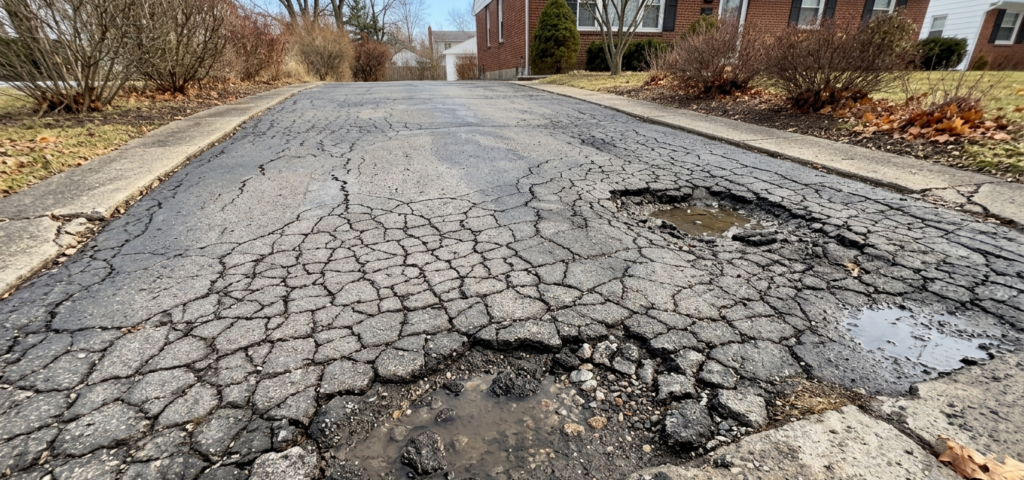
By the next year, it got ugly. Driving over the weak spots made things worse. The cracks multiplied and started connecting, forming a pattern called alligator cracking. It looks like reptile skin all along the surface.
If you see that, you’re in trouble. Alligator cracks mean the foundation under the asphalt is losing strength. All that water leaking below ruined the base layer, so the driveway couldn’t handle the weight of cars anymore.
This is why pros talk so much about the importance of crack sealing. It’s not just about stopping the crack you see on top; it’s about keeping water away from the foundation. Once the lower layers go bad, repairs get big and expensive.
By the end of the second summer, our driveway was losing the battle. And winter hadn’t even hit yet.
Winter 2: Potholes Started Forming
The next winter finished us off. By then, open cracks and soft sections were everywhere. The snow melted right into them, and when it froze again, the ice below pushed the surface upward. This repeated freeze thaw damage cycle made the situation much worse. It didn’t take long for those spots to cave in, and the first pothole showed up in the center of the driveway. Then another, and another.
That’s when we called a paving company. They checked it out and gave us the bad news: we’d need patching, base repairs, and a whole lot of new asphalt. Final estimate: Close to $8,000.
Two years earlier, we could have sealed everything for $500.
What’s especially frustrating is how easy it would have been to prevent all this. A quick repair in year one and sealing service would’ve kept water out and saved us from spending thousands. The difference clearly showed the true delayed maintenance cost of ignoring small issues.
Driveway Damage Timeline
| Stage | Typical Condition | Approximate Repair Cost |
|---|---|---|
| Hairline Cracks | Minor surface openings | Low |
| Expanding Cracks | Water penetration begins | Moderate |
| Alligator Cracking | Base weakening occurs | Higher |
| Potholes | Structural damage present | High |
| Reconstruction | Extensive pavement failure | Very High |
Why Sealing and Drainage Both Matter in Buffalo, NY
Most people think sealcoating is about curb appeal. It isn’t — or at least, that’s not the main reason to do it. Sealcoating creates a protective barrier that blocks water from penetrating the surface, slows oxidation from UV exposure, and keeps the asphalt flexible enough to handle temperature shifts without cracking. In Buffalo’s climate, those three things matter enormously.
What our paving contractor pointed out — something we never would have caught ourselves — was a drainage problem. Our driveway had settled unevenly over the years, and instead of shedding water toward the edges, it was pooling slightly toward the center. That standing water was accelerating the damage from below and above at the same time. It’s the kind of thing a professional spots in ten minutes that a homeowner would never notice.
When asphalt repair professionals do a proper assessment, they’re looking at more than surface cracks. They evaluate drainage flow, pavement edge deterioration, joint separation, sub-base stability, and early signs of structural shifting. Catching those issues before they compound is how you avoid a repair bill with a comma in it.
What to Watch For — and When to Call
Driveway damage follows a predictable pattern. It starts with hairline cracks that are easy to dismiss, especially if the driveway still looks fine from the street. Then those cracks widen. Water gets in. The base weakens. Alligator cracking appears. Then potholes. By that stage, you’re not patching anymore — you’re rebuilding.
Here’s a simple rule: if you can see a crack, water can get into it. That’s your window to act cheaply. Once you start seeing interconnected cracks or soft spots underfoot, the base is already compromised and the cost goes up significantly.
The moment you notice anything — even hairline cracks — is the right time to call for an inspection. Most reputable paving contractors will assess your driveway and give you an honest read on where things stand. Early action almost always means more options and lower costs.
Why Go With a Pro?
DIY repair kits might get you through for a year, but professionals know what to look for. They’ve got the materials, tools, and experience to spot things you might miss, like soft spots under the surface, and fix them right. A pro can tell you if you just need sealing or if there’s a bigger issue brewing.
Reliable asphalt solutions help extend pavement life and prevent costly future repairs.
Professional asphalt solutions are made for dealing with both the obvious and the unseen issues. Homeowners usually only pay attention to the cracks they can actually see, but good paving contractors tend to look deeper into what’s underneath, the load-bearing capacity, how drainage moves, and the overall, durable future of the surface. This bigger view often results in fixes that work better and last a lot longer.
For residents across Buffalo and the nearby communities, arranging periodic driveway checkups is probably one of the safest ways to safeguard your asphalt investment. Catching small problems early prevents them from progressing into large-scale reconstruction projects.
If your driveway’s looking rough or starting to crack, don’t wait. Call a pro like All Pro Paving Service at (716) 666-4241 and ask for an inspection. It’s the easiest way to avoid the headaches we dealt with.
Conclusion
Ignoring those first cracks seemed harmless enough. The driveway worked fine. We didn’t notice a problem until it was a big, expensive one.
But here’s the truth: water and freezing weather don’t care if you’re busy. Left alone, small cracks always turn into big problems. What starts out as a minor repair becomes a project with a comma in the price tag.
Addressing small issues early provides excellent preventive maintenance ROI because minor repairs cost far less than major reconstruction.
If you’re seeing any cracks, don’t wait. Get an inspection. Seal, repair, and protect your driveway before it turns into a giant bill. Trust me, it’s not worth putting off.
Whether your property is located in Amherst, Cheektowaga, West Seneca, Orchard Park, Hamburg, Lancaster, Depew, or anywhere throughout the Buffalo area, maintaining asphalt pavement should be viewed as an ongoing investment rather than a one-time expense. Small maintenance tasks performed at the right time can dramatically improve pavement longevity and reduce lifetime ownership costs.
Our experience proved that asphalt crack progression rarely stops on its own. Once moisture enters the pavement system, deterioration typically accelerates with every season. Taking action early remains the most effective strategy for preserving driveway performance and avoiding unnecessary repair expenses.
FAQ
What happens if I don’t fix driveway cracks?
Water sneaks in, damages the base, and eventually, you get bigger cracks and potholes.
How quickly do cracks spread?
Buffalo weather speeds things up. All that freeze-thaw action can take a crack from annoying to serious in a few seasons.
Does sealing early really save money?
Yes. A few hundred bucks now saves you thousands in repairs later. That’s just smart maintenance and demonstrates strong preventive maintenance ROI.
What are the stages of driveway deterioration?
It starts with hairline cracks, gets wider, then alligator cracking, then potholes, and, finally, full structural failure. These are the typical driveway deterioration stages.
When should I call for repairs?
Right when you notice cracks. The earlier you act, the less you’ll pay. Professional asphalt repair services can often stop problems before they become major expenses.
For more detailed technical information on crack sealing and pavement maintenance, the Federal Highway Administration’s pavement preservation resources and Pavement Interactive are both excellent references.
But if your driveway looks anything like ours did, just pick up the phone and call a company like All Pro Paving Service at (716) 666-4241, who knows what they’re doing. You won’t regret it.