
If you live in North Buffalo, South Buffalo, Eggertsville, or Snyder, you already know the freeze-thaw cycle around here cracks asphalt like nobody’s business, which is why many Buffalo property owners compare concrete vs asphalt solutions before choosing a new driveway surface. Look at your driveway. Those wide cracks, the sinking edges, that pothole near the garage that keeps coming back—Those are signs the base underneath has failed, which often leads to major asphalt failure if not properly repaired.
A lot of paving companies will sell you a patch or a sealcoat. Quick fix, low price, sounds good right? Problem is, it won’t last. Three months later, the cracks are back. When the base is shot, you cannot patch your way out of it.
You need a full-depth replacement. Tear out the old. Put down fresh stone. Compact it right. Pave it thick. Yes, it costs more up front, which is why many homeowners first check driveway pricing before committing to a full replacement. But you stop paying every spring for temporary bandaids. That is the difference between a real fix and throwing money away.
At All Pro Paving Service, we are professional paver installers in Buffalo, NY, serving neighborhoods from Amherst (14221) to West Seneca (14224). Below is our exact 7-step process for asphalt driveway installation—the same commercial-grade method we use for homes just minutes from Delaware Park and commuter properties near the Kensington Expressway.
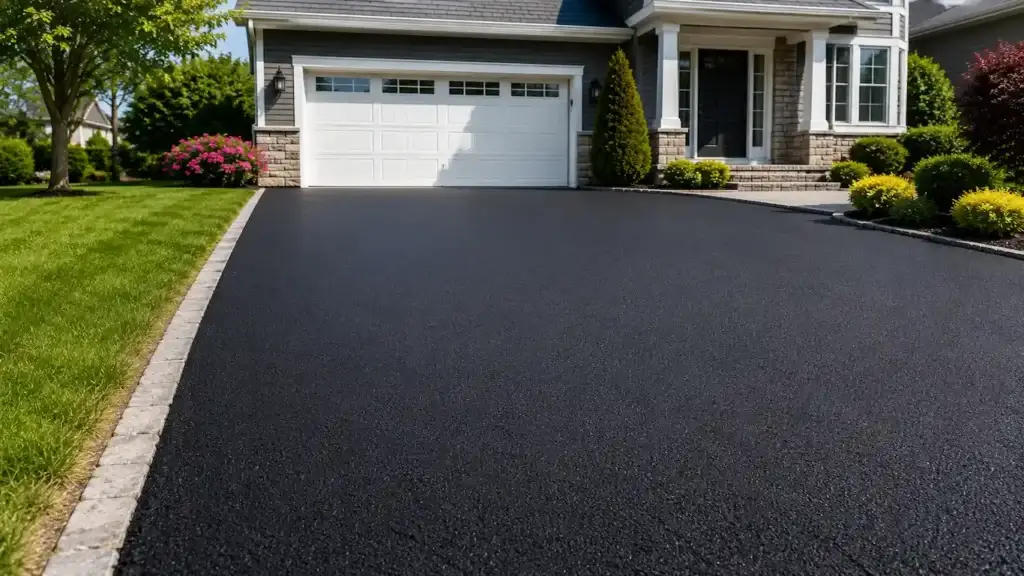
A Real-World Example: Why Full Replacement Matters
We recently completed a full-depth asphalt replacement near Delaware Avenue after repeated frost heaving destroyed the original driveway. The previous homeowner had tried three separate patch repairs over five years. Each one failed by February. Only after excavating to 12 inches, installing fresh angular base stone, and using a polymer-modified tack coat did the driveway finally survive a full Buffalo winter.
That is the difference between a Buffalo asphalt company that understands freeze-thaw mechanics and a general handyman with a bag of cold patch.
Step 1: Full Excavation & Subgrade Preparation
Before we become asphalt paving specialists for your property, we become excavators. We remove the existing failed asphalt, the compromised base stone, and 8–12 inches of native soil.
Why this matters in Western New York:
The clay-heavy soil common near Scajaquada Creek and the sandy shifts close to the Outer Harbor require different stabilization. Our local paving team identifies your soil type during the free on-site estimate.
Signs you need Step 1:
- Widespread alligator cracking
- Sinking or settled driveway edges
- Potholes that return after every repair
- Standing water 24 hours after rainfall
Not sure if you need a full replacement? Our local asphalt contractor offers free inspections at your home. Call 1 716 666 4241.
Step 2: Crushed Stone Sub-Base Installation (The Structural Layer)
We install 6–8 inches of clean, angular crushed stone. Angular aggregate locks together under compaction; round gravel rolls and creates ruts under vehicle weight, which is a common reason homeowners switch away from gravel driveways.
Semantic Note (Industry Expertise):
This layer acts as a capillary break, preventing moisture from wicking upward from the saturated water table near Cazenovia Creek. Without this, your asphalt will fail within 3–5 years.
Our equipment:
We use commercial-grade vibratory rollers—not hand tampers—to achieve proper compaction density.
Step 3: Precision Grading & Drainage Control
Standing water is the #1 enemy of asphalt in Erie County NY. We grade your sub-base to direct snow melt and rain toward municipal drains or approved swales, following modern stormwater management practices.
The engineering standard:
A minimum drainage gradient of ¼ inch per foot, sloping away from your garage or home foundation.
For homes near Humboldt Park, where stormwater management is historically challenging, we often install a shallow swale to prevent flooding of your new driveway.
Step 4: Asphalt Binder Course & Tack Coat Application
The asphalt binder layer (1.5–2 inches thick) is the structural workhorse of your driveway. Above it, we spray a tack coat—a liquid asphalt emulsion that acts as a glue between the binder and the surface course.
Why this matters for driveway paving specialists:
Without tack coat, the top layer will delaminate (slide and separate). We use a polymer-modified tack coat that remains flexible during deep freezes—critical for driveways along Main Street and Sheridan Drive.
Step 5: Hot Mix Asphalt Placement (The Surface Course)
The final surface course is a smooth 9.5mm NYSDOT-approved hot mix asphalt. It arrives at your property at 275°F+ and must be placed immediately.
Our commitment as a Buffalo asphalt company:
We source our hot mix from local batch plants only. We never haul asphalt from outside the Buffalo-Niagara region, because cooled asphalt will not achieve proper compaction density.
Thickness standard for residential driveways:
3–5 inches total compacted depth (binder + surface).
Step 6: Commercial-Grade Paving & Compaction
We pave with a sonematic screed paver—the same equipment used for municipal parking lots and Niagara Falls Boulevard commercial projects. Hand-raking cannot achieve the same flatness or compaction uniformity.
The edge restraint technique:
We compact the driveway edges first and create a slight crown (higher center, lower sides). This forces snow melt toward the edges rather than cutting ruts down the middle of your driveway.
For driveways in the Eggertsville area, where older homes have narrower access points, we adjust our paver width to avoid damaging mature landscaping.
Step 7: Final Rolling, Curing Schedule & Sealcoating Rules
The final roller pass knits the aggregate together, closing the surface to water intrusion and reducing future cracking.
Curing timeline for Buffalo’s climate:
- First 72 hours: No driving or parking (temperature dependent)
- First 90 days: No sealcoating (new asphalt needs to outgas)
- First 6 months: Full cure (humidity slows this process)
What our customers appreciate:
We return after 90 days to inspect for any hairline thermal checks and apply hot-applied crack filler if needed—at no additional charge.
Signs Your Buffalo Driveway Needs Full Replacement (Not Just Patching)
Many homeowners call us asking for repair, but we diagnose the need for full asphalt driveway installation when we see:
| Symptom | What It Means |
| Cracks wider than ½ inch | Base failure |
| Sinking edges | Subgrade erosion |
| Potholes returning after filling | Full-depth failure |
| Vegetation growing through cracks | Complete structural breakdown |
| Standing water after light rain | Improper grading |
If your driveway shows any of these signs, patch repairs are temporary. Only full-depth asphalt replacement will last 20+ years.
Why Buffalo Winters Destroy Asphalt Faster
The freeze-thaw expansion cycle is uniquely aggressive in Western New York. Water seeps into microscopic cracks, freezes at 32°F, expands by 9%, and fractures the asphalt from within. This repeats 40–60 times per winter near Lake Erie, which is why Buffalo winters are so tough on pavement.
How All Pro Paving Service builds for this climate:
- Polymer-modified tack coat for flexibility
- Angular stone base for drainage
- Proper crown for snow melt runoff
- NYSDOT-spec hot mix for cold-weather durability
Frequently Asked Questions
How long does asphalt driveway installation take in Buffalo, NY?
For a standard 2-car driveway (approximately 600–800 sq ft), our paver installers in Buffalo, NY complete the 7-step process in 2–3 days, weather permitting.
What is the best time of year for asphalt paving in Buffalo?
Late spring through early fall (May–October), when ground temperatures stay above 50°F. We book spring installations for Kenmore and Tonawanda residents as early as March if the frost is out of the ground.
How thick should a residential asphalt driveway be?
3–5 inches total compacted depth. Surface course: 1.5 inches. Binder course: 1.5–2.5 inches. Base stone: 6–8 inches.
Does snow damage new asphalt driveways?
Snow itself does not. But metal snowplow blades and aggressive ice chipping can. Wait 30 days before using a plow, and use plastic edge protectors.
How long before I can drive on new asphalt?
72 hours for passenger vehicles. 7–10 days for heavy trucks or RVs.
Do you serve Cheektowaga and surrounding areas?
Yes. We serve all of Erie County, including Cheektowaga, Lackawanna, Sloan, Depew, Lancaster, and Clarence.