
Knowing what equipment professional asphalt paving contractors in Buffalo, NY use helps property owners make informed hiring decisions and recognize the difference between experienced professionals and crews that prioritize speed over quality. This is especially important in Buffalo, NY, where pavement must withstand heavy snowfall, road salt, spring moisture, and repeated freeze-thaw cycles. Proper equipment selection, asphalt temperature control, and compaction techniques all play a major role in creating pavement that lasts.
Selecting the right paving contractor involves more than comparing prices. The equipment used during excavation, asphalt placement, and compaction directly affects how long your driveway or parking lot performs.
Located in Buffalo’s 14226 ZIP code, All Pro Paving Service provides professional asphalt paving installation services throughout Erie County and surrounding Western New York communities. Our team regularly works with homeowners and businesses in Amherst, Cheektowaga, Tonawanda, Clarence, Lancaster, Hamburg, Orchard Park, and West Seneca.
With experience serving properties near Delaware Park, the University at Buffalo South Campus, Niagara Falls Boulevard, and major local roadways, we understand how Buffalo’s weather conditions, traffic patterns, and seasonal changes affect asphalt performance. Whether installing residential driveways or commercial parking lots, our team uses professional asphalt paving equipment and proven techniques designed for long-lasting pavement.
What Equipment Is Used to Pave Asphalt?
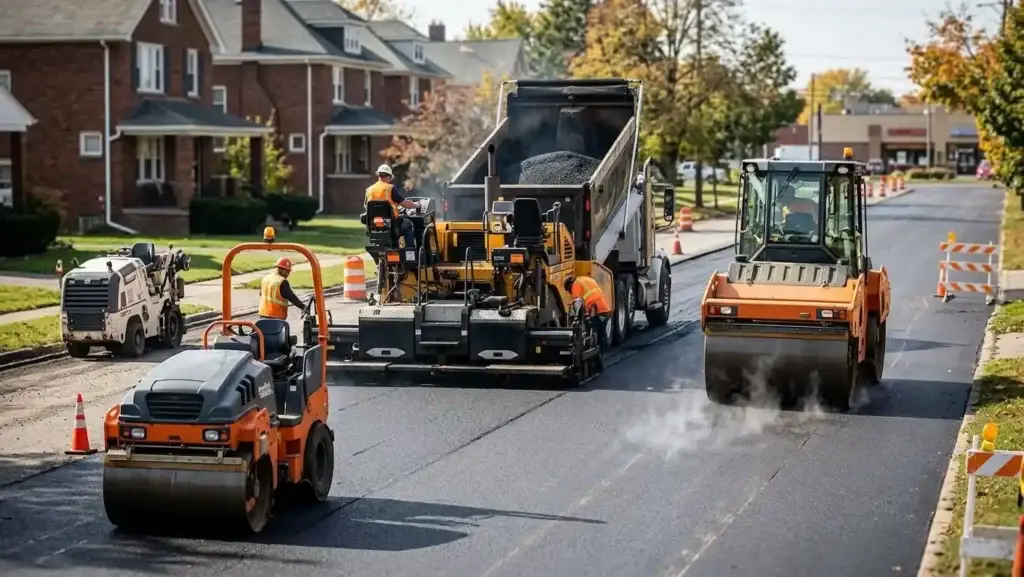
Professional contractors rely on several types of asphalt paving equipment because every stage of the process of asphalt paving requires specialized machinery. Using the correct equipment helps improve surface quality, pavement longevity, and overall project efficiency.
So, what do the professionals use to pave asphalt? No surprise here: it takes more than one machine to get the job done right.
It all starts well before the hot asphalt gets poured. First, the crew checks out the site, gets the surface ready, and takes care of any repairs. Only when the area’s prepped do the specialized machines roll out, hauling, spreading, leveling, and compacting the new asphalt.
You’ll usually see a few key machines on any project: asphalt pavers, road rollers, material transfer vehicles, milling machines, and asphalt plant equipment. Each has its own job, but together they deliver a surface that’s smooth, strong, and built to handle traffic for years.
Contractors who care about quality always keep their equipment in top shape because even a tiny mechanical issue can ruin a job.
| Equipment | Primary Purpose | Why It Matters | Common Use |
| Asphalt Paver | Places hot mix asphalt evenly | Maintains thickness and smoothness | Driveways, parking lots, roads |
| Vibratory Roller | Compacts asphalt layers | Improves density | All paving projects |
| Pneumatic Roller | Seals pavement surface | Creates tighter finish | Commercial paving |
| Material Transfer Vehicle | Maintains asphalt consistency | Reduces segregation | Large projects |
| Milling Machine | Removes damaged pavement | Prepares surface | Repaving projects |
Asphalt Pavers: The Machine That Lays the Road
The asphalt paving machine is considered the centerpiece of modern paving operations. Professional asphalt pavers are designed to maintain consistent thickness, proper material flow, and a smooth finish throughout the entire asphalt paving installation.
The asphalt paver is the workhorse. Without one, you just can’t get that clean, even layer.
People ask, “What does an asphalt paver actually do?” Easy: it takes hot asphalt from the truck and lays it evenly on the prepared surface. It controls the thickness, the width, basically everything about the layer you’ll drive or park on.
Modern asphalt pavers use automatic grade control systems, screed controls, and temperature monitoring technology to maintain consistent pavement thickness and surface smoothness.
The screed assembly controls the final width, slope, and smoothness of the asphalt mat, helping operators achieve consistent results across different paving projects.
Of course, machines don’t run themselves. Skilled operators are constantly fine-tuning the paver’s speed, the material, and the screed settings. Even with the best machine in the world, you need the right people to deliver truly pro results.
Rollers: The Key to Proper Compaction
Proper compaction is one of the most important stages in the process of asphalt paving because it increases pavement density, reduces air voids, improves load-bearing capacity, and extends the overall lifespan of the asphalt surface.
So the surface looks nice, but that’s only half the job; the new asphalt needs to be packed down tight. Enter the road rollers.
Hot, just-poured asphalt is full of tiny air bubbles. The road rollers press those out, making the surface dense and much tougher. Miss this step, and you’ll see cracks and potholes way sooner than you want.
Depending on the project, you’ll see a mix of smooth steel rollers and pneumatic rollers. The mix helps boost density and fine-tune the finish.
Timing matters a lot. If the asphalt gets too hot or too cold before rolling, it never gets fully compacted. That’s why a skilled crew works in sync, moving quickly once the asphalt hits the ground.
Done right, rolling also makes water drain off better and helps your new driveway or lot last longer with less maintenance.
Material Transfer Vehicles: Preventing Segregation
Some of the bigger equipment, like material transfer vehicles, don’t show up on every site, but they’re essential for larger jobs.
These material transfer vehicles shuttle hot asphalt from delivery trucks to the paver. While doing that, they remix the asphalt to keep the temperature even and prevent the materials from separating.
Separation or segregation is bad news. It’s when the bigger rocks drift away from the finer stuff, creating weak points in the pavement. Using transfer vehicles means you get a more uniform, durable finished product. You’ll see these mostly on highways or big commercial jobs, but they show how the right equipment makes all the difference.
Milling Machines: Preparing the Surface
Large commercial and municipal paving projects often rely on material transfer vehicles to improve mix consistency and reduce thermal segregation. This helps contractors produce smoother pavement with fewer weak spots.
Before you can lay new asphalt, sometimes you need to take off the old stuff. Milling machines make that possible. They grind away just the top layer of damaged pavement and leave the good foundation intact.
This preps a smooth, level surface for new asphalt paving installation, and it gets rid of cracks, ruts, or any other problems lurking below. Bonus: the old, milled off asphalt can usually be recycled in future projects, which is great for both budgets and the planet.
Good surface prep makes or breaks a new paving job.
Asphalt Plant Equipment: Where It All Starts
Every great pavement project begins long before asphalt touches the ground, and it all starts at the plant. Here, the ingredients, aggregates, sand, binder, and fillers are blended at controlled temperatures using asphalt plant equipment.
Modern asphalt plant equipment uses computerized controls to nail down the right mix every time. Getting the temperature and proportions precise makes the asphalt easier to work with and ensures it holds up right, even as seasons change.
When the mix is right, everything else falls into place.
How the Paving Process Unfolds
When you know the steps, it’s clear why every piece of asphalt paving equipment matters.
First, contractors look at what’s there, testing soil and checking for repairs or grading needs. Next is prepping the surface, whether that’s milling machines removing old asphalt or getting the base level with grading equipment.
Hot asphalt arrives from a plant, ready to be placed. The asphalt paving machine spreads it out consistently. Road rollers jump in right away, packing it down before it cools. Then you wait for it to set, and finally, the new surface is ready for cars.
Every step relies on good timing, sharp operators, and reliable equipment throughout the process of asphalt paving.
How to Spot High-Quality Equipment
Not every paving company brings the same tools to the job. True professionals invest in modern machines, and you can spot the difference.
Some important equipment quality indicators include automatic grade control systems, temperature monitoring technology, properly maintained screeds, clean hydraulic systems, and routine equipment servicing. These features help contractors produce consistent paving results on every project.
Look for equipment that’s clean, well-maintained, and running smoothly, with no leaking oil, strange noises, or rusted out spots. The best contractors keep up on maintenance, so their machines stay reliable and accurate.
Modern features like automatic grade controls and temperature monitoring make a big difference. A professional crew doesn’t rely on shortcuts. They use the right number of machines, all working together, and pay close attention to every phase of the job.
If you want peace of mind about equipment and workmanship, All Pro Paving Service can help. Call (716) 666-4241 to get a team that cares about quality and uses the best gear for long-lasting results.
Essential Equipment for a Driveway
Wondering what’s needed for a new driveway? It’s basically a scaled-down version of a commercial job, but you still need the right machines:
Start with excavation or grading to set the base.
Lay down hot asphalt with an asphalt paving machine.
Compact it all with road rollers for strength.
You probably won’t need material transfer vehicles unless it’s a massive job, but the core process of asphalt paving is the same. Using professional asphalt paving equipment prevents problems like potholes, cracks, and drainage issues down the road.
Why Pro Equipment Matters
Some folks ask if it’s worth it to go with a company that uses the big, modern machines. In short: absolutely.
Up-to-date asphalt paving equipment helps contractors work faster, hold more even temperatures, and create a finish that lasts. Old or poorly maintained gear leads to early repairs and extra headaches.
You want your new pavement to last as long as possible. The right machines, skilled operators, and smart asphalt paving installation techniques make that happen.
So whether you’re looking at a new driveway or a parking lot, always choose a contractor with experience and solid equipment. It’s a smart investment.
All Pro Paving Service proudly provides professional asphalt paving services throughout Buffalo, Amherst, Cheektowaga, Hamburg, Orchard Park, West Seneca, Lancaster, Clarence, Tonawanda, and nearby Western New York communities. Whether you need residential driveway paving or commercial parking lot paving, our experienced team uses professional asphalt paving equipment to deliver long-lasting results.
For a hassle-free, professional paving job, reach out to All Pro Paving Service at (716) 666-4241. Their experienced team and reliable equipment guarantee smooth, tough pavement every time.
Frequently Asked Questions
What equipment do pros use for asphalt paving?
They rely on asphalt pavers, road rollers, material transfer vehicles, milling machines, and asphalt plant equipment.
What’s an asphalt paver?
It’s the asphalt paving machine that spreads hot asphalt evenly over the surface before rolling.
How do rollers work?
Road rollers press out air pockets, making the asphalt denser and the pavement stronger.
How do I know if my contractor’s equipment is up to par?
Look for clean, well-maintained, modern machines and strong equipment quality indicators. The finished surface should be smooth with no visible flaws.
What’s needed for a driveway?
You’ll need grading equipment, an asphalt paving machine, and road rollers. That’s what creates a strong, smooth driveway.
Want to go deeper? Check out the National Asphalt Pavement Association for more on pavement construction and best practices.
Conclusion
You can’t count on luck for a great driveway or parking lot. Quality comes from professionals using the right asphalt paving equipment at every step, from prepping the base to laying and rolling the final surface.
Understanding each phase, along with the role every machine plays, helps you hire a contractor you can trust. Experienced teams and modern gear mean pavement that stays smooth and solid for years.